How to Launch a Solopreneur Business in 30 Days: The 2026 Speed-to-Market Blueprint
Learn how to launch a solopreneur business in 30 days with this proven speed-to-market framework covering validation, MVP building, first-customer acquisition.
How quickly can you actually launch a solopreneur business? The answer in 2026 is 30 days — if you follow the right framework.
With 29.8 million solopreneurs now contributing $1.7 trillion to the U.S. economy, the barrier to entry has never been lower. But speed matters more than perfection.
According to recent data from the U.S. Census Bureau, solopreneurs account for the vast majority of small businesses, proving that solo business models are not just viable — they are becoming the dominant form of American entrepreneurship.
This guide walks you through the exact 30-day framework successful solopreneurs use to go from idea to first paying customer in 2026, without raising capital or building a team.
Table of Contents
The Speed-to-Market Advantage: Why 30 Days Matters
Launch speed creates competitive advantage.
Research from Carta shows that solo founder rates have climbed sharply over the past decade, with more than a third of startups founded on the platform in 2025 led by a single founder. This acceleration reflects a fundamental shift: building is no longer the bottleneck — validation is.
The 2026 Reality Check
Traditional business advice says spend 6 months planning. Modern solopreneurs spend 6 days validating and 24 days building their first offer.
The difference is that they understand building is largely automated now, and the real challenge has shifted to being seen.
Speed wins for three reasons:
Market feedback arrives faster — you learn what customers actually want, not what you think they want. Momentum compounds daily, since each small win builds psychological fuel for the next step. And opportunity costs decrease, because every month spent planning is a month competitors capture market share.
Related: Best tools for solopreneurs
The 30-Day Launch Framework: Week-by-Week Breakdown
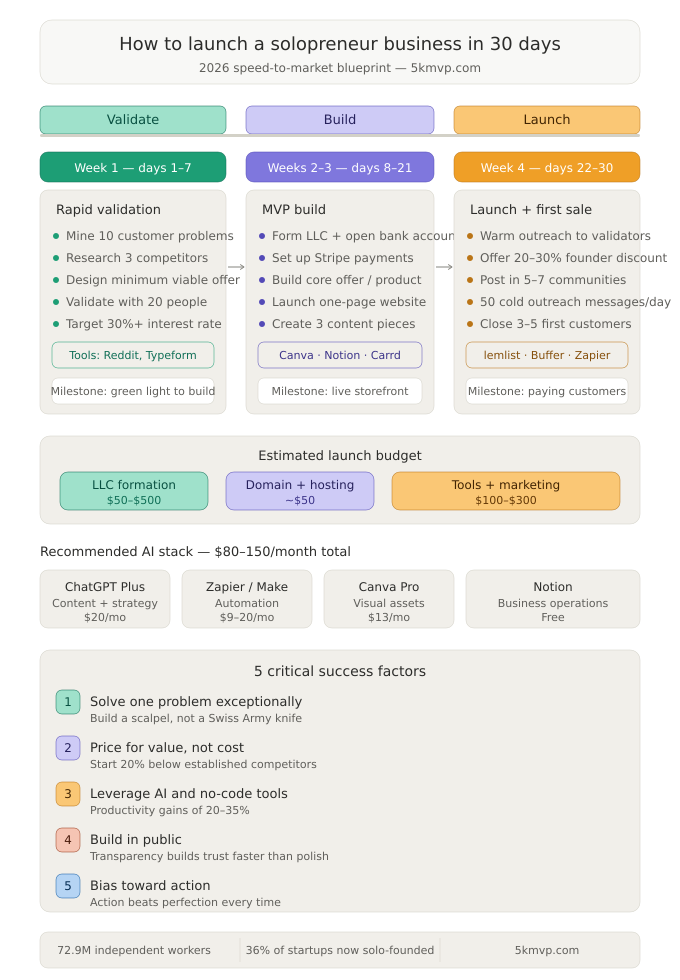
This framework is built on three phases: Validate (Week 1), Build (Weeks 2–3), and Launch (Week 4).
Week 1: Rapid Market Validation (Days 1–7)
Validation before building prevents wasted effort.
Days 1–2: Problem Mining
Pull real customer language from three sources: Reddit threads in your target niche sorted by "top" in the past year, Amazon reviews for competing products (look for 3-star reviews showing unmet needs), and industry-specific forums or Facebook groups where people search for "frustrated" or "struggling with."
A common piece of expert advice is that before launching any solopreneur business, you should pull at least 10 pains or desires from customer comments, forum threads, or call notes.
Document exact phrases customers use. These become your marketing copy later.
Days 3–4: Competitive Intelligence
Identify 3 to 5 existing solutions and note their pricing tiers to find the gap, the common complaints in their reviews (your opportunity), and what they do well (the table-stakes features you'll need too).
Aim to walk away with 3 competing offers, their price bands, and at least one identified gap in the market.
Days 5–6: Offer Design
Create your Minimum Viable Offer (MVO) around one core outcome you deliver, a clear before/after state for customers, a specific timeline or deliverable, and a price point that starts around 20% below premium competitors.
Day 7: Pre-Launch Outreach
Message 20 people in your target market — not to sell, but to validate. Try a script like: "I'm building [solution] for [specific problem]. If I could deliver [outcome] in [timeframe], would that solve a real problem for you?"
Track responses. A 30%+ interest rate is your green light to build.
Weeks 2–3: Minimum Viable Product Build (Days 8–21)
Build the smallest version that delivers value.
Days 8–10: Technical Foundation
Set up your business infrastructure. Form an LLC through a service like ZenBusiness or Northwest Registered Agent (typically $50 to $500 depending on state), open a free business banking account through a provider like Mercury, and connect Stripe or PayPal for payment processing.
Apply for a free Employer Identification Number (EIN) from the IRS before opening your dedicated business bank account. For accounting, start with Wave (free) or a paid tool like QuickBooks Solopreneur.
Related: Tools to build an MVP
Days 11–14: Core Offering Creation
Your MVP depends on your business model.
Service businesses should create a service delivery framework: an intake questionnaire template, a standard operating procedure document, and a delivery timeline spreadsheet.
Digital product founders should build a first version — for example, 3 to 5 pre-built Notion templates, 5 core lessons for an online course (10 to 15 minutes each), or one core workflow for a SaaS tool that solves the primary problem.
Physical product founders should source their first inventory by ordering samples from 3 suppliers, testing the product personally for 48 hours, then selecting the best option and ordering a small initial batch of units.
Use AI tools strategically wherever possible — AI-powered productivity tools have been a major driver behind the rising share of solo-founded startups.
Days 15–17: Build Your Storefront
Your online presence needs three components.
A one-page website built with a tool like Carrd, Super.so with Notion, or Framer should include a clear headline stating the problem you solve, 3 to 5 bullet points of outcomes, social proof (even beta tester feedback counts), a clear call-to-action button, and a contact method.
Set up a Google Business Profile for free local SEO visibility and increased discoverability.
Link Stripe Checkout or Gumroad to your site for payment infrastructure.
Days 18–21: Content Foundation
Create 3 pieces of foundational content that demonstrate expertise: one long-form blog post (1,500+ words) solving your target customer's top problem, one short video (3 to 5 minutes) showing your process or explaining a key concept, and one downloadable resource (template, checklist, or guide) as a lead magnet.
Optimize for AI discoverability — the real challenge in 2026 is being seen, not building.
Week 4: Launch and First Customer (Days 22–30)
Execute your go-to-market strategy.
Days 22–24: Warm Outreach
Return to the 20 people from Day 7 who showed interest. Try an updated message: "Remember when you said [problem] was a challenge? I just finished building [solution]. Would you be open to being a founding customer?"
Offer a founder's discount (20 to 30% off) in exchange for detailed feedback after delivery, permission to use their testimonial, and referrals to 2 to 3 people in their network.
Days 25–27: Community Launch
Post in 5 to 7 relevant online communities: industry-specific subreddits (read the rules first), Facebook groups where your customers gather, LinkedIn groups in your niche, Twitter/X with relevant hashtags, and Indie Hackers or Hacker News for tech products.
Share your journey, not a sales pitch — something like "I spent 30 days building [solution] for [problem]. Here's what I learned," then mention you're taking first customers.
Days 28–30: Direct Outreach at Scale
Send roughly 50 personalized cold outreach messages per day across LinkedIn connection requests with a custom note, email outreach to targeted prospect lists, and direct messages on Twitter/X to people posting about your problem space.
Automation tends to pay off here too — businesses that implement it often see solid productivity gains, so tools like lemlist or Instantly.ai can help you scale outreach without losing personalization.
Close your first 3 to 5 customers by day 30.
Critical Success Factors: What Makes or Breaks the 30-Day Launch
Five factors determine launch success.
1. Solve One Problem Exceptionally
Don't build a Swiss Army knife. Build a scalpel. Analyses of successful one-person companies consistently point to the same pattern: intense focus on one narrow problem for one specific customer type, rather than broad feature sets.
2. Price for Perceived Value, Not Cost
Your pricing signals your positioning. Too low reads as amateur; too high without proof reads as unrealistic. The sweet spot is usually around 20% below established competitors, paired with a clear value story.
3. Leverage AI and No-Code Tools
Traditional barriers no longer exist. The modern solopreneur stack typically includes ChatGPT Plus for content creation and strategy, Zapier or Make for workflow automation, Canva Pro for visual assets, and Notion for business operations.
Most high-performing solopreneurs spend somewhere between $80 and $150 per month on their complete AI stack.
4. Build in Public
Transparency creates trust faster than polish. Share your building journey on Twitter/X, LinkedIn, or through a weekly newsletter, documenting challenges, wins, and lessons. This approach builds an audience before you need customers.
5. Bias Toward Action
Perfection kills momentum. Launch with minimal viable offerings and iterate based on real customer feedback. Every day spent refining before launch is a day without market feedback.
Common Pitfalls: What Derails Most 30-Day Launches
Avoid these four traps.
Analysis paralysis shows up as spending Week 1 researching competitors instead of talking to customers. Fix it by time-boxing research to 2 hours per activity, then moving on when the timer goes off.
Feature creep is the urge to add "just one more feature" before launch. Fix it by locking your core feature list on Day 8 and sending any new ideas to a "Version 2" list for after launch.
Perfectionist design means redesigning your website for the fifth time instead of launching. Fix it by using a proven template and only customizing colors and copy.
Waiting for motivation means only working on days you "feel inspired." Fix it with a daily time block — show up whether you feel like it or not, since momentum creates motivation, not the other way around.
Post-Launch: Your First 30 Days After Day 30
The launch is just the beginning.
Days 31–45: Deliver Exceptional Value
Overdeliver on your first 5 customers. Respond to messages within 2 hours, add unexpected bonuses (an extra call, a bonus template, an extended timeline), and ask for feedback at every milestone. These customers become your testimonial base and referral engine.
Days 46–60: Document and Systematize
Turn your delivery process into a repeatable system: standard operating procedures for each service component, email templates for common customer questions, an onboarding checklist for new customers, and a project management board in Trello or Notion. This foundation enables scaling beyond the 30-day mark.
Real-World Case Study: Sarah Chen's $420K Solo Launch
Sarah Chen launched her AI-powered design agency in January 2025 using this exact framework.
Her stack: ChatGPT Plus, Canva Pro, and Zapier. Her timeline: 30 days to first customer. Within eight months, she hit $420K in annual revenue while working 25 hours weekly.
Her key insight was mastering AI tools to scale solo business workflows before hiring a single employee.
Sarah's validation phase took 5 days. She interviewed 15 potential customers, identified that design agencies charged too much for simple brand packages, and positioned herself 40% below competitors with 48-hour turnaround times.
Her MVP combined a Notion-based design brief, Canva templates customized per client, and a standardized delivery process.
She acquired her first 3 customers through LinkedIn cold outreach on Day 28, delivered exceptional results, and earned 7 referrals within 30 days of launch.
The Mental Game: Mindset Shifts That Accelerate Launch
Your psychology determines your timeline.
Shift from perfectionist to iterationist: replace "I need to get this perfect before showing anyone" with "I need market feedback to know what perfect even means."
Shift from knowledge seeker to action taker: replace "I need to learn more before I start" with "I'll learn faster by doing than by studying."
Shift from future-focused to now-focused: replace "Once I build all these features, customers will come" with "I'll get one customer this week with what I have today."
Tools and Resources for Your 30-Day Launch
Essential resources organized by launch phase.
Validation phase: Reddit for searching customer problems, Google Trends for validating search volume, Answer the Public for finding common questions, and Typeform for creating validation surveys.
Building phase: Carrd or Framer for landing pages, Notion for business operations, Canva for visual design, Loom for video creation, and Stripe for payment processing.
Launch phase: lemlist or Instantly.ai for cold email outreach, Buffer or Hypefury for social media scheduling, Cal.com for meeting scheduling, and Zapier for workflow automation.
Related: Market demand for solopreneur tools and Best CRM tools for solopreneurs
Your 30-Day Launch Checklist
Print this checklist and track daily progress.
Week 1: Validate
- Mine 10 customer problems from Reddit, forums, and reviews
- Research 3 competitor offerings and pricing
- Design your Minimum Viable Offer
- Validate with 20 target customers
- Achieve a 30%+ interest rate
Week 2: Build Foundation
- Form an LLC and get an EIN
- Open a business bank account
- Set up payment processing
- Create a service delivery framework or product MVP
- Write standard operating procedures
Week 3: Build Presence
- Launch your one-page website
- Set up a Google Business Profile
- Create 3 pieces of foundational content
- Build a lead magnet
- Set up email collection
Week 4: Launch
- Reach out to your Day 7 validation group
- Post in 5 to 7 relevant communities
- Send roughly 50 personalized outreach messages daily
- Close 3 to 5 first customers
- Celebrate and document your learnings
Scaling Beyond the First 30 Days
The 30-day launch creates momentum. Here's what comes next.
Month 2: Systematize and Automate. Focus on repeatability: document every process, automate repetitive tasks with Zapier, create templates for common deliverables, and build a content calendar.
Month 3: Scale Customer Acquisition. Double down on what worked in Week 4. If cold outreach worked, hire a VA to scale it. If content worked, publish twice a week. If community engagement worked, join more communities. If referrals worked, build a referral program.
Months 4–6: Add Revenue Streams. Successful solopreneurs rarely rely on one income source. Consider digital products (templates, courses), higher-tier service offerings, recurring revenue models (retainers, subscriptions), and affiliate partnerships.
A meaningful share of solopreneurs reach six-figure annual income, and most got there by diversifying revenue streams after achieving initial product-market fit.
Frequently Asked Questions
Can I really launch a solopreneur business in 30 days?
Yes, if you focus on speed over perfection. The 30-day timeline forces prioritization and eliminates feature creep. Launch with minimal viable offerings and iterate based on real customer feedback.
How much money do I need to launch in 30 days?
Roughly $500 to $2,000 covers the essentials: LLC formation ($50–$500), domain and hosting (~$50), basic tool subscriptions ($100–$200/month), and an initial marketing budget ($500–$1,000). Many solopreneurs start with under $1,000.
What if I don't have a technical background?
No-code tools have eliminated most technical barriers. Use Carrd for websites, Zapier for automation, and AI tools like ChatGPT for content. Technical skill is no longer the bottleneck it once was.
Should I quit my job before launching?
No. Launch while employed. The 30-day framework is designed for evenings and weekends (2 to 3 hours daily). Quit only after reaching $3,000 to $5,000 in monthly recurring revenue.
What's the biggest mistake new solopreneurs make?
Building before validating. Many ideas fail not because they're bad, but because they're mismatched with solo work. Spend Week 1 on validation to avoid wasted effort.
How do I know if my idea is good enough?
Your idea doesn't need to be revolutionary. It needs to solve a real problem people will pay to fix. The validation step in Week 1 tells you if demand exists.
What business model works best for solopreneurs?
Service businesses launch fastest because they don't require product development. Digital products scale better but take longer to build. Choose based on your skills and speed requirements.
How do I compete with established companies?
You don't compete on features — you compete on speed, personal service, and niche positioning. Large companies can't move as fast or care as much as a solo founder.
Final Thoughts: Speed as Strategy
The 30-day launch framework works because it forces clarity.
You can't build everything in 30 days, so you build what matters. You can't perfect everything in 30 days, so you ship good enough. You can't wait for perfect conditions in 30 days, so you start now.
The solopreneur economy is accelerating dramatically in 2026, creating unprecedented opportunity for fast-moving founders. The barrier to entry is lower than ever, the tools are cheaper and more powerful, and the market is larger and more accessible.
What separates successful launches from failed attempts isn't the idea, the budget, or even the skill level. It's the willingness to move fast and iterate.
Your 30 days start now.